
/ Method
Redundancy & failover engineering: N+1, 2N, hot-standby and the discipline of designing for the day something fails
Quick answer
Redundancy is not 'more boxes' — it is an engineering posture. N+1 is right for commercial loads where a sub-system can take 90 seconds to recover. 2N is the only honest answer for hospital, broadcast and Tier-III data-centre work where any visible downtime is unacceptable. Hot-standby (instantaneous, sub-100 ms) is appropriate for life-safety; warm-standby (5–30 seconds) for commercial; cold-standby (minutes-to-hours) is a procurement strategy, not a redundancy strategy. The discipline is to design for the failure mode, not to multiply boxes.
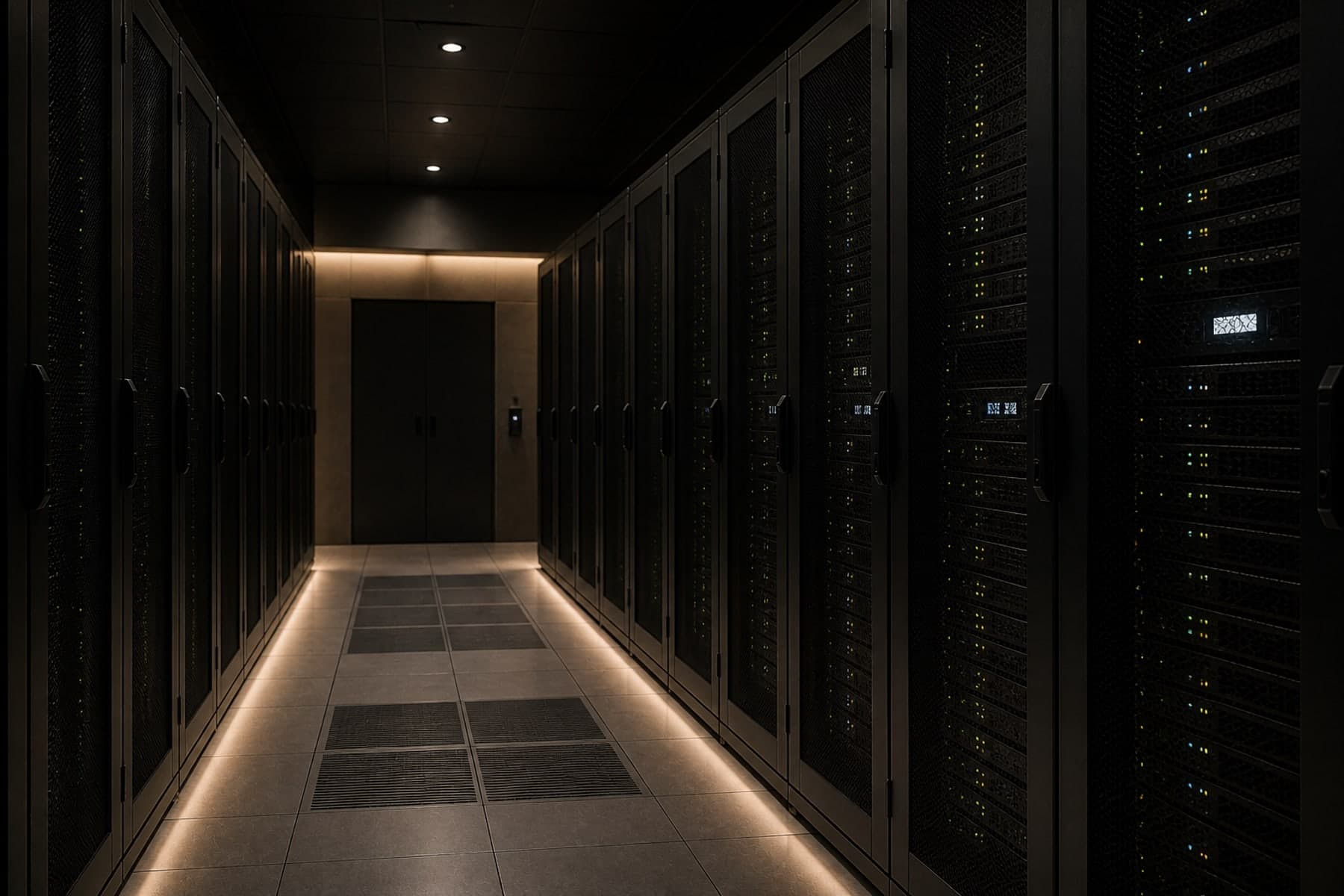
Redundancy and failover engineering is the discipline of designing for the day a sub-system fails, and it sits across power, networking, control systems, life-safety and AV in equal measure. The mistake we encounter most often is the assumption that redundancy is the same thing as 'two of everything' — it is not. Redundancy is a design posture about how a system behaves at the moment of failure, and there are at least five distinct architectures, each correct for a different operational reality.
The five canonical patterns are N, N+1, N+2, 2N and 2(N+1). N is no redundancy — every device is single-point-of-failure. N+1 means one spare unit across the population — a four-pump chilled-water system with a fifth pump that activates if any of the working pumps fails. N+2 means two spares, used for very large populations or where simultaneous failure of two units is plausible. 2N is full mirroring — two complete identical systems running in parallel, either of which can carry the full load. 2(N+1) is two complete N+1 systems — used in Tier-IV data centres where even the redundant system has its own redundancy. The cost ladder is steep: N+1 typically adds 25–40% to capex; 2N typically doubles capex; 2(N+1) typically triples it.
The behaviour at the moment of failure decides which pattern is the right answer, and that behaviour breaks into four categories. Cold-standby means the spare unit is powered off and must be brought up manually — appropriate where the recovery window is minutes to hours and the procurement window is days to weeks (e.g. a spare AHU motor on the shelf, a spare network switch in the IT cupboard). Warm-standby means the spare unit is powered and configured but not actively carrying load — switchover takes 5–30 seconds (e.g. a hot-spare BMS controller, a stand-by UPS in line-interactive mode). Hot-standby means both units are powered and synchronised — switchover is sub-100 ms (e.g. a double-conversion online UPS, a fire-alarm panel in true redundant configuration). Synchronous redundancy means both units are actively carrying load and continue carrying load with no transition — the only acceptable pattern for life-safety, broadcast, and Tier-IV data-centre work.
Power redundancy is where the discipline is most visible and most often misengineered. The mainstream Indian commercial pattern is a single utility feed, a single DG set, a single online UPS — three serial single-points-of-failure dressed up as a triple-redundancy story. The honest commercial design has the utility feed and a DG set as N (not redundant against each other), with the UPS providing ride-through during the 20–30 second start window of the DG. For Tier-II commercial that is acceptable; for hospital, broadcast and Tier-III data-centre work, the design must move to dual utility feeds where the grid permits it, two DG sets in N+1, and 2N UPS with independent battery banks. The cost ladder is steep but defensible against the operating reality.
Redundancy topology
redundancy-topologyDiagram · described
Redundancy / failover topology
A dual-feed topology used for tier-2-equivalent IT and life-safety loads. Utility A and B converge at an automatic transfer switch, with UPS A and UPS B operating in parallel with maintenance bypass to twin PDU branches that feed dual-power-supply loads.
Protocol matrix
Redundancy mode × switchover behaviour
| Mode | Switchover | Operator impact | Cost premium |
|---|---|---|---|
| Cold standby | Manual install of spare (hours) | Full outage during recovery | 1.05–1.10× of N |
| Warm standby | Manual cutover (minutes) | Brief outage; manual sequence | 1.15–1.25× of N |
| Hot standby | Automatic, sub-second | Imperceptible to operator | 1.40–1.60× of N |
| 2N (full mirror) | None — both active | Zero perceived downtime | 1.80–2.00× of N |
Premiums are illustrative against an N baseline at 2026 Indian prices for mainstream IT, BMS and power scope.
Network redundancy is where the discipline most often collapses into pseudo-redundancy. A single core switch with two uplinks to two ISPs is not redundant — the switch itself is single-point-of-failure. True network redundancy demands two physical switches in stack or virtual-chassis with link-aggregation across the stack, two ISP feeds on physically separate fibre paths, BFD (Bidirectional Forwarding Detection) discipline for sub-second failover, and the awareness that the most common failure is a misconfigured spanning-tree event, not a hardware fault. The hardware redundancy is the easier half; the protocol discipline is what makes it actually work at the moment of failure.
Controller redundancy in BMS and lighting is the third discipline that hides single-points-of-failure under a redundancy veneer. A Honeywell EBI or Siemens Desigo CC server can be specified in a primary/secondary cluster — but if both servers share a single SQL database on a single storage volume, the storage is the single-point-of-failure. The same applies to KNX line-couplers, DALI bus extenders and addressable fire-alarm loops — every node has its own failure envelope and the redundancy story must trace the actual signal path, not the high-level architecture diagram.
Life-safety redundancy is its own discipline because the consequence of failure is not negotiable. Redundant loops and dual power supplies on addressable fire-alarm panels are the engineering practice we design to, with NBC 2016 Part 4 and IS 2189 as the governing references; whether a given building is required to carry them is a code question for the licensed fire consultant on record, not one this article settles. Loop A and Loop B on a redundant addressable panel must take physically separate cable paths — running both loops in the same cable tray defeats the purpose. Dual power supplies (mains + standby battery) must auto-switch on mains failure with a documented switchover test; we test this at quarterly intervals in our AMC contracts.
Failover testing is the discipline that decides whether the redundancy actually works on the day. Untested failover is theoretical failover. The AMC discipline is to engineer the test schedule into the contract: quarterly UPS battery autonomy tests, semi-annual DG live-load transfer tests, monthly BMS controller cluster switchover tests, monthly fire-panel loop continuity tests. The cost of testing is real (a recurring engineering line); the cost of not testing is finding out at the moment of failure that the redundancy was theoretical.
Cross-system redundancy is the part of the design that touches every discipline. A hospital with full N+1 power, 2N UPS and dual ISP feeds is still single-point-of-failure if the fire-alarm panel sits on a single dedicated transformer with no UPS backup. A broadcast facility with full 2N AV-over-IP distribution is still single-point-of-failure if the master clock has no backup. The discipline is to trace the signal and power path end-to-end across every discipline and ask, at each node, 'what is the failure consequence and what is the recovery window' — and then specify the redundancy at every node where the consequence exceeds the acceptable window.
The final discipline is graceful degradation — designing so that when a sub-system fails, the rest of the building continues to function rather than cascade-failing. A failed BMS server should not bring down lighting; a failed UPS should not bring down the fire alarm; a failed AV-over-IP encoder should not bring down the HVAC controls. The boundary discipline at each integration point — clear protocol stops, watchdog timers, fail-safe defaults — is what separates an integrated building from a fragile one. Integration is not the same as coupling; the well-integrated building is loosely coupled at the protocol layer and each sub-system can fail without taking the others with it.
Redundancy is a posture, not a parts list. Specifying 'two of everything' without engineering the failure modes, the switchover behaviour and the testing discipline produces capex that does not buy the operational reliability the client thinks it bought. The honest design walks the failure tree before it specifies the redundancy.
Key engineering takeaways
- Redundancy is a design posture about behaviour-at-failure, not a parts-count multiplier — N+1, 2N and 2(N+1) each describe a different operational reality.
- Switchover behaviour matters more than redundancy count — cold/warm/hot/synchronous distinguish a 30-second outage from no visible outage.
- A single utility feed, single DG, single UPS in serial is not triple-redundant — it is three single-points-of-failure dressed up as a redundancy story.
- Network redundancy demands stacked physical switches, dual ISP feeds on physically separate paths and BFD discipline — not just two uplinks.
- Controller redundancy must trace the actual signal and storage path — primary/secondary servers sharing a single SQL volume are pseudo-redundant.
- NFPA 72 is the international cross-reference here, not an instrument in force. Life-safety redundancy is prescribed by NBC 2016 and IS 2189 and is non-negotiable above thresholds — redundant loops must take physically separate cable paths.
- Untested failover is theoretical failover — engineer the test schedule into the AMC at handover, not after the first incident.
- Graceful degradation is part of the design — a failed sub-system must not cascade into the rest of the building; clean protocol boundaries enforce this.
/ Reference table
Redundancy patterns vs operational tier
| Building tier | Power | Network | BMS/Lighting | Life-safety | Capex premium vs N |
|---|---|---|---|---|---|
| Tier-I commercial / residential | N (UPS for ride-through) | Single uplink + 4G fallback | N | N (per code) | Baseline |
| Tier-II mid-commercial | N (utility + DG + UPS in series) | Dual uplink, single switch | N+1 controllers | N (per code, tested quarterly) | ~15–20% |
| Tier-III commercial / mid-hospital | N+1 (DG redundancy) + 2N UPS | Stacked switches + dual ISP, BFD | N+1 servers, mirrored storage | N+1 panels, redundant loop paths | ~50–80% |
| Tier-IV / broadcast / large hospital | 2N (dual utility, dual DG, 2N UPS) | 2(N+1) across two physical paths | 2N server cluster, mirrored database | 2N panels, fully redundant loops, dual power | ~150–250% |
| Data centre (Uptime Institute Tier-III/IV) | 2N or 2(N+1) per Uptime spec | Multiple Tier-1 ISPs on physical diversity | 2N controllers | 2N panels, mandatory dual feed | ~200–400% |
Capex premiums are typical 2026 Indian-market bands; exact numbers depend on the load profile, the physical site and the available utility infrastructure.
Common mistakes
What we see go wrong
- Specifying 'two of everything' without engineering the failure modes.
- Why it fails — Capex doubles without buying the operational reliability the client expects; the failure modes still cascade because the underlying coupling was not engineered.
- What we do instead — Walk the failure tree first — list the sub-systems, the failure consequences and the acceptable recovery windows, then specify redundancy where the consequence exceeds the window.
- Treating a single utility + single DG + single UPS as triple-redundant.
- Why it fails — The three are in series, not parallel — failure of any one is a load outage. The architecture has three single-points-of-failure, not three redundancies.
- What we do instead — Move to N+1 DG and 2N UPS where the building tier demands it; specify dual utility feeds where the grid permits.
- Primary/secondary BMS or lighting servers sharing a single storage volume.
- Why it fails — The storage is the single-point-of-failure; the redundancy story collapses on storage failure, which is the more common failure than server hardware.
- What we do instead — Mirror the storage with synchronous replication or SAN-level redundancy; document the recovery procedure at handover.
- Network redundancy with two uplinks but a single core switch.
- Why it fails — The switch is single-point-of-failure; both uplinks become unavailable on switch reboot or hardware failure.
- What we do instead — Stack two physical switches in MLAG / virtual-chassis configuration; aggregate links across the stack.
- Fire-alarm Loop A and Loop B running in the same cable tray.
- Why it fails — Loops were specified redundantly but the physical path is shared — fire damage to the tray takes both loops out simultaneously, defeating the redundancy.
- What we do instead — Specify physically separate cable paths for Loop A and Loop B at design stage; mark up the routes on the wiring drawings explicitly.
- Closing the project without a documented failover test schedule.
- Why it fails — Untested failover is theoretical; the operations team discovers redundancy gaps at the moment of failure, not before.
- What we do instead — Engineer the test schedule into the AMC at handover — quarterly UPS, semi-annual DG transfer, monthly BMS controller switchover, monthly fire-loop continuity. Document the test results.
Deployment realities
What the drawings never show
Triple-redundancy on paper, three serial single-points in practice
Utility + DG + UPS in series is the default commercial pattern; calling it triple-redundant is the marketing pitch, not the engineering reality. Specify what the actual independent paths are.
Switchover noise is a real failure mode
Many warm-standby systems work in the lab but introduce a 200–500 ms blip at switchover that is invisible to HVAC and lighting but visible to broadcast AV and to synchronous database writes. Test at the actual load.
Network failover demands protocol discipline
Hardware redundancy is the easier half — STP / RSTP / MLAG / BFD discipline at the configuration layer is what makes the failover sub-second. Misconfigured STP cascades into multi-minute outages.
Battery degradation is the silent UPS killer
VRLA banks degrade at 5–8% per year; a 30-minute autonomy bank at year one is a 12-minute bank at year five. Quarterly autonomy tests catch this; annual visual inspections do not.
Redundant fire-alarm loops in shared cable trays
Loops A and B specified for redundancy but routed through a single tray defeat the redundancy in any fire-affecting-the-tray event. Insist on physically separate paths with cable-route drawings at handover.
Configuration files are part of the redundancy
Server hardware can be replaced; the configuration is what makes the building work. Versioned, off-site backups of every config file (ETS .knxproj, Rako .pro, Honeywell point database) are part of redundancy engineering.
When this architecture fails
Failure modes worth knowing in advance
Each redundancy architecture has a known failure envelope; specifying outside the envelope produces predictable problems at the worst moment.
N+1 UPS for a load that grows beyond original sizing without the spare growing in proportion.
Load growth eats the redundancy margin; the system silently becomes N+0 without anyone noticing until a failure exposes it. Specify a 25% growth allowance at sizing.
Warm-standby BMS server with a 30-second switchover, used for a process-critical pharma or hospital load.
The 30-second blackout window violates the operational requirement; the redundancy specification matches the load but does not match the operational reality.
2N power but single network path for the building-management telemetry.
Power is redundant but the operations team's visibility is single-point-of-failure; they cannot manage the redundant systems if they cannot see them. Telemetry redundancy follows control redundancy.
Cold-standby for a high-availability application where the procurement window is longer than the recovery window.
The spare is on the shelf but procurement of the actual unit takes 4–6 weeks; the cold-standby is procurement strategy, not redundancy. Distinguish them in the contract.
Untested 2N power architecture in a 5-year-old facility.
Battery degradation, contactor wear, automatic transfer-switch (ATS) timing drift — all silently degrade and surface at the next genuine utility outage. Annual full-transfer tests are mandatory, not optional.
What ages poorly
Lifecycle weak points to plan around
VRLA UPS battery banks
Capacity degrades at 5–8% per year; a 30-min autonomy bank becomes a 12-min bank at year 5. Quarterly autonomy tests; lithium-ion gives a flatter curve.
DG fuel quality and starter discipline
Fuel oxidation in 6–12 months without polishing; starter battery sulfation in 18–24 months. Monthly load-tests and quarterly fuel polishing are not optional.
Automatic transfer switches (ATS)
Contactor wear at 1,000–5,000 transitions; full-load test cycles age the contactors faster — there is a real argument for testing under simulated load, not full load.
Spanning-tree (STP/RSTP) configurations
Topology drift as the network grows; the STP that worked at year-one may produce unexpected re-convergence events at year-five. Annual STP audits catch this.
Stored configuration files
Off-line backups go stale; the year-three change request requires the year-three config, not the year-one config. Versioned config storage with monthly verification is the discipline.
Cross-vendor BACnet gateways
Firmware drift on either side of the gateway produces silent mis-mappings at the 24–36 month mark; semi-annual integration audits catch this before it surfaces at the operator.
/ Frequently asked
Quick answers from the practice.
- Is 2N always better than N+1?
- No — 2N costs roughly 2× of N capex, ~1.5× of N+1, and is only the right answer where the operational requirement is zero visible downtime (hospital OR, broadcast on-air, Tier-IV data-centre). For Tier-II/III commercial with a 90-second tolerance, N+1 is the honest specification and the cost premium is defensible.
- How does redundancy interact with the UPS/BESS sizing tool?
- The /tools/bess-sizer tool sizes for the worst-case ride-through; redundancy multiplies that. A 30-min ride-through with 2N redundancy is two independent 30-min banks, not a single 60-min bank. The architecture decision flows from the failure-mode analysis; the sizing flows from the load and ride-through requirement.
- Does graceful degradation conflict with deep integration?
- No — they are different concepts. Integration is about data flowing between systems; graceful degradation is about the consequence of a sub-system failing. The well-integrated building has rich data exchange at the protocol layer and loose coupling at the failure layer — a failed BMS server does not bring down lighting, even though the BMS would normally inform the lighting.
- What is the failover testing cadence we should specify?
- Quarterly UPS battery autonomy tests, semi-annual DG live-load transfer tests, monthly BMS server cluster switchover, monthly fire-alarm loop continuity, annual full-system failover drill. Document the cadence and the procedure in the AMC; the cost is real but the alternative is finding out at the worst moment.
- Is cold-standby a real redundancy strategy?
- Cold-standby is a procurement strategy — the spare is on the shelf but the recovery window is the time to install. Calling it redundancy in a contract where the operational requirement demands hot-standby is the source of the worst incidents. Distinguish the two explicitly in the design and in the AMC scope.
- Will TechnoGuru deliver redundancy engineering across all disciplines?
- Yes — power, network, BMS, controller, life-safety and AV redundancy are engineered together at design stage. The failure-tree analysis is part of the design package; the AMC carries the failover testing discipline. Reference: hospital and broadcast deployments in the practice's portfolio.
/ What to do next
Three next steps for redundancy scope
- Size the UPS ride-through and BESS →Worst-case ride-through against the actual load; redundancy multiplies the sizing.
- Read the lithium vs VRLA insight →Battery chemistry economics — and what it means for the redundancy architecture.
- Send the building drawings to the studio →We walk the failure tree across power, network, BMS, life-safety and AV — and return a layered redundancy recommendation within three working days.
Engineering toolkit
Tools that go with this read
If this article gave you a question worth pricing, these calculators give a defensible first number.
- Lead intake
Project Brief Wizard
Six structured questions, a written response within two working days. The fastest path to engaging the practice on a real project.
6 questions · 2-day replyOpen - BMS · Energy
Energy & Efficiency Estimator
Adjust building variables and see indicative energy and CO₂ savings (kWh) for a BMS-driven energy upgrade plus daylight-harvesting LED retrofit. Conservative; defensible in a first conversation.
kWh · CO₂ savedOpen - BMS · BESS
BESS Sizer
Peak demand + solar + storage strategy in, indicative LFP battery size, inverter rating, daily throughput and cell life out. Vertiv, Delta and Fuji-class deployments.
LFP · kWh · cell lifeOpen
Related engineering decision
The comparison behind this question.
Decision · Networking & IT
On-premises IP PBX vs cloud telephony
You are deciding where the call platform should live for a site whose voice has an operational job, not just a desk-phone job.
Decision · Power & UPS
Online UPS vs line-interactive UPS — the topology decision
You are choosing UPS topology for a specific load group and need to know whether a transfer event is acceptable to the equipment behind it.
· Where to go next
The wider authority graph for this topic.
Engineering pages
Read further
Editorial — about this surface
TechnoGuru Operational Continuity Practice
The operational continuity practice engineers for environments where the system simply cannot drop. UPS sizing, battery and BESS engineering, redundancy architecture, fail-over discipline and the operational drills that make sure continuity holds when the grid does not.
Reviewed against operational-continuity field realities — every recommendation is held to what survives a drilled fail-over.
Last reviewed
19 May 2026
Engineering domains
UPS and BESS sizing · Power-redundancy architecture · Fail-over and load-shedding design · Mission-critical observability
Operating environments
Healthcare and clinical environments · Datacenter-adjacent facilities · Broadcast and live-event venues · Mission-critical institutional sites
/ Discuss your project
If this article matches a brief you are working on, the next step is a short brief — a project lead replies to it directly.
We do not run sales pipelines. The first reply comes from a project lead, within two working days, and it goes straight to the engineering question rather than a brochure.