
/ ELV
Command-and-control room engineering: three envelopes, per-envelope power, hand-off boundaries
Quick answer
Command-and-control room engineering is built around separated operational zones, resilient support systems, communication continuity and disciplined hand-off between operators. Public project references stay at this architectural level; restricted screening, layout, credential and implementation details are not published.
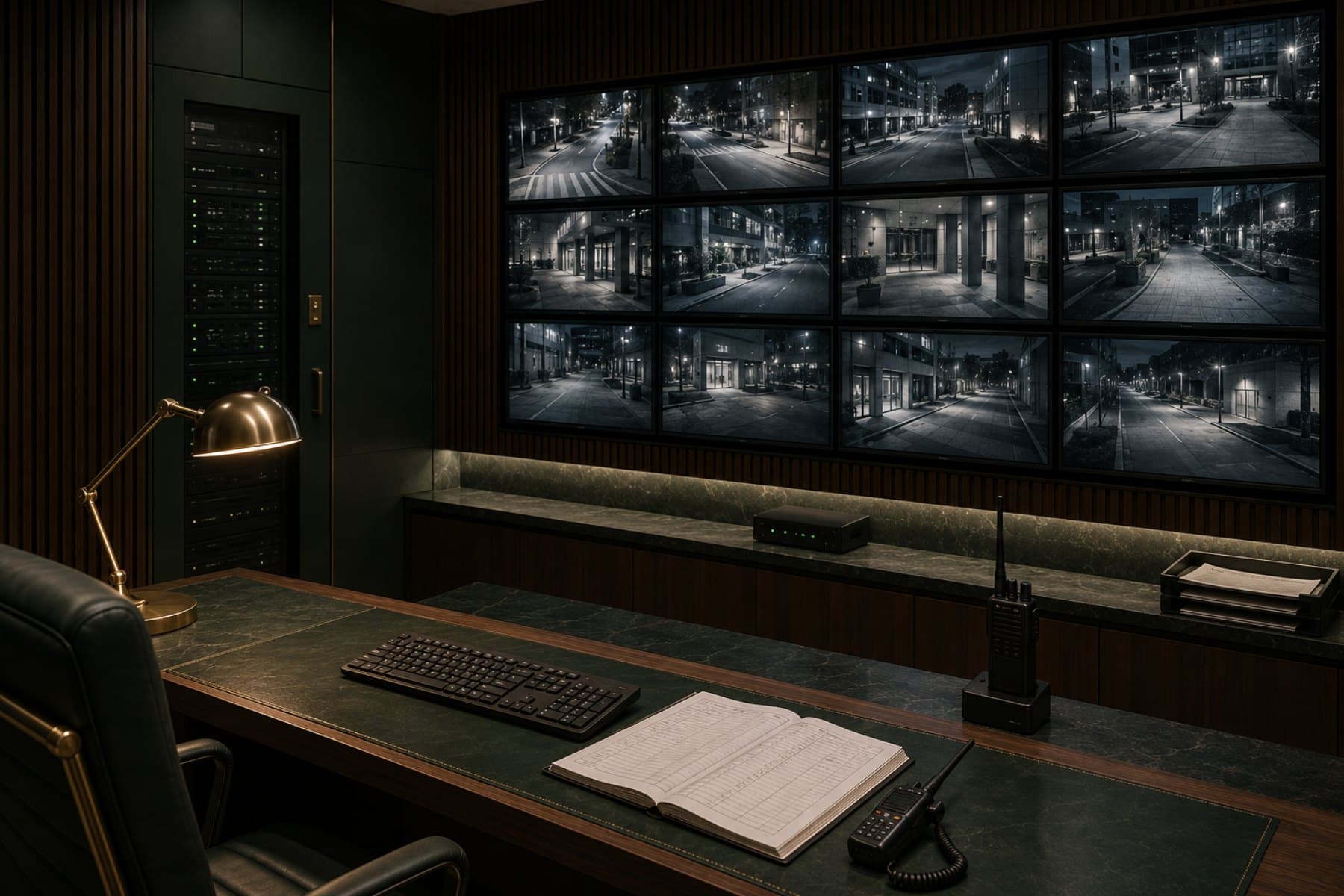
Command-and-control room engineering is its own discipline. The procurement default treats the room as 'large boardroom with surveillance' — the operational reality treats it as a multi-envelope facility with per-envelope power, dedicated earthing, hand-off boundaries and operator-correlation surfaces. Government perimeter operations, transit-control rooms, power-plant SCADA centres and broadcast master-control rooms all share the same engineering pattern.
Separated operational zones
The public framing is intentionally abstract: entry-management, surveillance-and-communication, and command-or-briefing functions are treated as separate operating zones. The published article discusses coordination principles without disclosing site-specific screening architecture, credential flows, physical layout or quantities.
Per-envelope power and earthing strategy
Each operating zone needs resilient power and earthing discipline appropriate to its public-safety role. The public guidance explains the principle of fault isolation without describing private power topology or restricted equipment dependencies.
Hand-off boundaries between envelopes
Handoffs between entry-management, monitoring and operator response are engineered so the facility team has a coherent workflow. Public copy stays at workflow level and does not publish restricted event paths, camera layouts or operator-console topology.
Convenience layer in parallel with screening, never bypassing
Convenience features should never replace the underlying operating procedure. Public guidance names the governance principle without publishing credential mechanics, bypass scenarios or adversary-oriented detail.
Operator-correlation surface
The operator surface should give authorised facility staff a coherent view of relevant events. The public article keeps that point at operational level and omits restricted correlation paths, camera positions and system topology.
Configuration baseline discipline
Every controller across the three envelopes — UPS, fire panel, BMS, Wi-Fi controller, IP-PBX, audio DSP, lighting controller, RFID reader — has its configuration baseline exported offline at handover and re-exported after every firmware refresh. Any controller is recoverable from a clean slate within the same business day if a field unit is replaced. The recovery procedure is rehearsed at each AMC visit.
AMC discipline matches the operational tier
Command-and-control rooms operate at Mission-Critical tier — named engineer, contracted critical-hours support, quarterly preventive maintenance, monthly failover testing, configuration baseline review at every visit. The AMC is engineered against the operational tier, not against a generic commercial baseline.
Callout — what command-room procurement most miss
A command room is a facility, not a boardroom. Specify operating zones, resilient support systems, hand-off discipline and lifecycle ownership. Public references should describe that coordination without disclosing restricted implementation detail.
References
1. IEEE 1100 — recommended practice for powering and grounding electronic equipment (Emerald Book).
2. TIA-942 — telecommunications infrastructure for data centres.
3. NFPA 70 (NEC) — National Electrical Code (US cross-reference).
4. IS 3043 — earthing practice for low-voltage installations.
Three-envelope command facility topology
government-command-topologyDiagram · described
Government command-and-control facility topology
A public-safe command facility topology. Operating zones are separated into entry-management coordination, surveillance and communication, and command or briefing support. Each zone has resilient support systems and an explicit hand-off boundary without exposing restricted site layout or security architecture.
Key engineering takeaways
- Command-and-control rooms are multi-zone facilities, not ordinary meeting rooms.
- Resilient support systems and earthing strategy are planned by operating zone.
- Hand-off boundaries between zones are engineered, not improvised.
- Convenience features support operations but do not replace procedure.
- Operator surfaces should reduce fragmentation without exposing restricted topology.
- Configuration baseline export at handover and after every firmware refresh; clean-slate recovery within the same business day.
- AMC tier matches operational reality (Mission-Critical) — named engineer, contracted support windows, monthly failover testing.
/ Frequently asked
Quick answers from the practice.
- Why separated zones rather than one integrated system?
- Fault isolation and operator clarity. Public guidance can explain the principle without publishing private system topology, credential rules or restricted event paths.
- How is the convenience layer engineered against security?
- Convenience features support authorised operation but do not replace the underlying procedure. The public article keeps the point at governance level and avoids adversary-oriented detail.
- Does the AMC tier require named engineer?
- For Mission-Critical command-and-control deployments, yes. The named engineer is on the AMC contract document, with the escalation path documented in the AMC scope. Spare-pack inventory is held against the named engineer's response window, not against a generic spares pool.
/ What to do next
Three next steps for command-and-control scope
- Read the CCTV-for-critical-infrastructure insight →Pole foundations, HDPE under-conduit and civil-coordination discipline.
- Read the infrastructure-redundancy insight →Per-envelope UPS architecture and failover testing.
- Read the Koinadhara case study →Scope-level public-sector guest-house systems coordination reference.
Engineering toolkit
Tools that go with this read
If this article gave you a question worth pricing, these calculators give a defensible first number.
- Life-safety
NBC Compliance Checker
Building height, type and occupancy in — the life-safety and ELV systems NBC 2016 indicates for that building, citing NBC 2016 and the relevant IS codes.
NBC 2016 · IS codesOpen - Lead intake
Project Brief Wizard
Six structured questions, a written response within two working days. The fastest path to engaging the practice on a real project.
6 questions · 2-day replyOpen - BMS · Energy
Energy & Efficiency Estimator
Adjust building variables and see indicative energy and CO₂ savings (kWh) for a BMS-driven energy upgrade plus daylight-harvesting LED retrofit. Conservative; defensible in a first conversation.
kWh · CO₂ savedOpen
Related engineering decision
The comparison behind this question.
· Where to go next
The wider authority graph for this topic.
Engineering pages
Projects
Editorial — about this surface
TechnoGuru Operational Continuity Practice
The operational continuity practice engineers for environments where the system simply cannot drop. UPS sizing, battery and BESS engineering, redundancy architecture, fail-over discipline and the operational drills that make sure continuity holds when the grid does not.
Reviewed against operational-continuity field realities — every recommendation is held to what survives a drilled fail-over.
Last reviewed
20 May 2026
Engineering domains
UPS and BESS sizing · Power-redundancy architecture · Fail-over and load-shedding design · Mission-critical observability
Operating environments
Healthcare and clinical environments · Datacenter-adjacent facilities · Broadcast and live-event venues · Mission-critical institutional sites
/ Discuss your project
If this article matches a brief you are working on, the next step is a short brief — a project lead replies to it directly.
We do not run sales pipelines. The first reply comes from a project lead, within two working days, and it goes straight to the engineering question rather than a brochure.