
/ ELV
CCTV for critical infrastructure: pole foundations, HDPE under-conduit and the civil-coordination discipline
Quick answer
CCTV for critical infrastructure (government perimeter, protocol residence, transit hub, power-plant fence) is engineered through three disciplines that commercial CCTV rarely confronts: pole foundations sized per pole against the actual wind-load profile (not a flat-ground catalogue baseline), HDPE under-conduit laid during civil build-out with draw pits at every camera-pole base (so cable refresh is a pull, not a civil exercise), and chemical-earthing pits dedicated to the surveillance plant (not shared with the building's earthing schedule). Without those three, the estate looks fine on day one and is a road-cutting headache by year five.
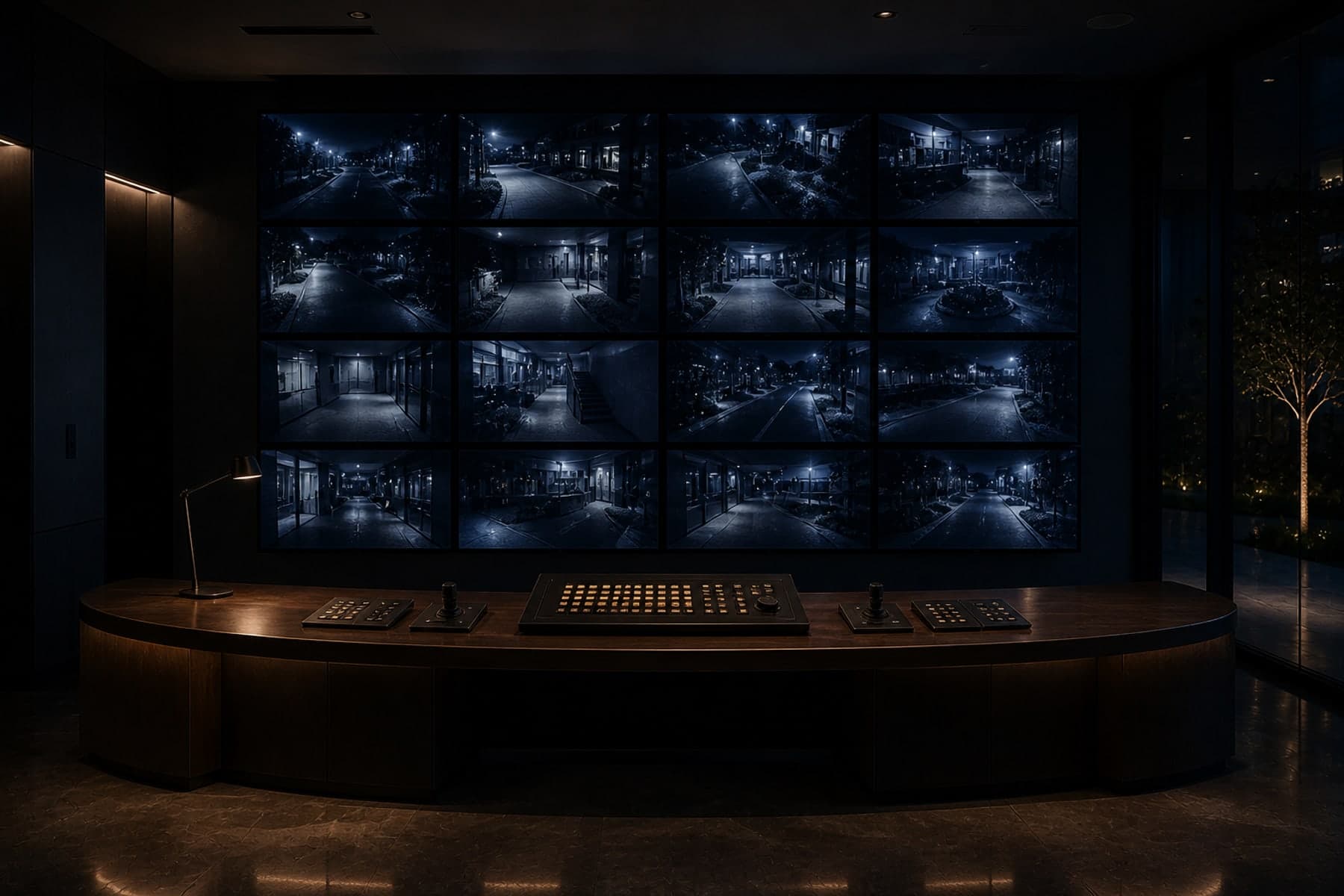
Critical-infrastructure CCTV is the category where the civil-and-cabling discipline outweighs the camera-and-VMS discipline. The cameras are off-the-shelf; the pole foundations, the under-conduit, the earthing and the per-pole maintenance access are the actual engineering. Get those wrong on day one and the estate is an unfixable problem by year five.
Pole foundations are calculated per pole
ANPR poles, perimeter-camera poles and PTZ-tracking poles on a hilltop or open-perimeter site face significantly higher wind load than a flat-ground commercial baseline. Catalogue foundation specs assume nominal wind exposure; real installations require per-pole foundation calculation against the local wind-load profile (IS 875 Part 3 for wind-load coefficients), with foundation depth and rebar profile specified per pole. Pole tilt is not a cosmetic concern — it corrupts plate-read accuracy for ANPR cameras, shifts the IR-illuminator coverage angle for night cameras, and degrades PTZ-tracking patrol presets.
HDPE under-conduit during civil build-out
The single most consequential civil-and-cabling coordination decision in critical-infrastructure CCTV is whether the cable trunks are laid as HDPE under-conduit during the civil build-out window, with draw pits at every camera-pole base. Without that, every post-handover cable refresh is a road-cutting exercise — and on a working perimeter road or a protocol-residence approach, road-cutting windows are vanishingly rare. 1-inch HDPE pipe at every cable bundle, draw pits at every pole base and at every bend in the route: the discipline is one day of civil work that saves a decade of road-cutting.
Chemical-earthing pits dedicated to the surveillance plant
Surveillance-plant earthing is its own engineering, not a share-with-the-building's-earthing-schedule afterthought. Chemical-earthing pits sized against the actual fault-clearance impedance of the plant — typically 4 pits dedicated to a perimeter-screening + camera-pole array, with the pits placed against the pole locations and the head-end rack, not against the building's existing earthing schedule. Without dedicated earthing, fault clearance degrades and PoE switch trip events become operationally visible.
Per-camera maintenance access on the AMC calendar
Outdoor cameras require an annual or post-monsoon maintenance access cycle — enclosure-seal inspection, lens-face clean, IR-illuminator alignment verification, pole-foundation visual inspection at the base-plate / grout interface. The maintenance access is engineered at design stage: every camera reachable from a single ladder position or a single basket lift, every pole foundation visible from ground level, every PoE port labelled against the camera position on the architectural drawing.
Hilltop voltage excursion and IP grade
Hilltop and remote-site surveillance plant faces grid-side voltage excursion that flat-ground commercial deployments rarely confront. IP67-class enclosures for underground (UVSS), IP66 for outdoor pole-mount, IP65 for under-eave protected installations; mainline voltage stabilizer ahead of the head-end PoE plant; surge protection (Type 1 + Type 2) at the head-end rack and at every camera-pole base. Without the surge-and-stabilizer discipline, sustained voltage excursion is the leading silent failure mode after monsoon-season grid disturbances.
ANPR vs general-surveillance camera class
ANPR cameras are specified against the plate-read use case (5-55 mm motorised lens, 1/10000 s shutter, electronic-iris with IR illumination, 2 MP supported sensor), not against general-surveillance bullet or dome class. Driver-photo cameras pair with the ANPR plate-read on the same pole, with separate cable runs and separate operator-correlation surface. The 4-pole array (ANPR + driver photo at the boom-barrier entry) is the engineering reference, not the 'X cameras at the gate' procurement default.
Operator correlation between gate event and approach road
The operator console for critical-infrastructure CCTV correlates the gate event (UVSS trigger, ANPR plate read, boom-barrier opening) with the approach-road camera coverage on the same surface — incident review pulls the gate event and the approach-road footage from the same timestamp range without switching consoles. The correlation discipline is engineered at the VMS layer, not at the operator gesture; a single-cause incident review surfaces both the gate event and the approach-road context.
Callout — what critical-infrastructure CCTV procurement most miss
The civil-coordination discipline is the actual engineering — the cameras are off-the-shelf. Specify the pole foundations per pole, the HDPE under-conduit during civil build-out, the dedicated chemical-earthing pits, the per-camera maintenance access on the AMC calendar, the surge-and-stabilizer chain, and the operator correlation surface. The camera class is the smallest part of the deployment.
Reference deployment context
Assam State Guest House at Koinadhara, Guwahati is a public-facing reference for guest-house ELV and entry-management coordination. The public summary stays at scope level; operational layout, quantities and restricted implementation details are kept out of the article.
References
1. IS 875 Part 3 — wind-load coefficients for structural calculation.
2. IS 3043 — earthing practice for low-voltage installations.
3. IEC 60529 — IP rating envelopes (IP65 / IP66 / IP67).
4. ONVIF Profile S/T/G — IP-camera interoperability.
Camera coverage geometry · lens × mount × distance
cctv-coverage-geometryDiagram · described
CCTV coverage geometry — FOV cones vs PPM bands
A top-down view of camera coverage geometry. Three camera classes (dome at 2.8 mm, bullet at 6 mm, PTZ at variable) are shown at representative mounting heights with their FOV cones projected onto a gridded floor plan. Identification-grade coverage (250 PPM), recognition (125 PPM) and observation (62 PPM) bands are marked. Real coverage tapers with distance; lens choice and mounting height set the actual coverage envelope.
Government command-and-control topology
government-command-topologyDiagram · described
Government command-and-control facility topology
A public-safe command facility topology. Operating zones are separated into entry-management coordination, surveillance and communication, and command or briefing support. Each zone has resilient support systems and an explicit hand-off boundary without exposing restricted site layout or security architecture.
Key engineering takeaways
- Pole foundations are calculated per pole against the local wind-load profile — not from a flat-ground catalogue baseline.
- HDPE under-conduit during civil build-out is one day of civil work that saves a decade of road-cutting for cable refresh.
- Chemical-earthing pits are dedicated to the surveillance plant — not shared with the building's earthing schedule.
- Per-camera maintenance access is engineered at design stage — every camera reachable from a single ladder or basket position.
- Mainline voltage stabilizer + Type 1 + Type 2 surge protection at the head-end and per-pole base — hilltop voltage excursion is the silent killer.
- ANPR + driver-photo pole pairs are the engineering reference at the boom-barrier entry — not 'X cameras at the gate'.
- Operator-console correlation between gate event and approach-road footage is a VMS-layer deliverable.
/ Frequently asked
Quick answers from the practice.
- Why HDPE specifically?
- HDPE (high-density polyethylene) is corrosion-resistant under buried-cable conditions, holds shape through monsoon-cycle ground movement, and accepts standard pulling lubricant for cable refresh. PVC under-conduit deteriorates under sustained outdoor exposure; metallic conduit corrodes.
- What is the cost premium for HDPE under-conduit during civil build-out?
- Typically 3-5% of the perimeter ELV cable budget, sometimes less when the civil contractor includes the HDPE pull in the road-base preparation. The saving against post-handover road-cutting is order-of-magnitude — typically 8-15× the up-front cost for any subsequent cable refresh.
- Will TechnoGuru coordinate the civil and ELV scope?
- Yes. Civil-and-ELV coordination is the binding constraint on critical-infrastructure CCTV. Public references such as Koinadhara are described only at scope level; site-specific layout and implementation details stay private.
/ What to do next
Three next steps for critical-infrastructure CCTV scope
- Try the CCTV calculator →Approach-road and main-gate camera storage and bandwidth budget.
- Read the CCTV-for-hospitals insight →PPM discipline and per-camera bitrate sizing.
- Send the perimeter and road drawings →We mark up pole-foundation, HDPE under-conduit and earthing-pit placement against your actual site.
Engineering toolkit
Tools that go with this read
If this article gave you a question worth pricing, these calculators give a defensible first number.
- Life-safety
NBC Compliance Checker
Building height, type and occupancy in — the life-safety and ELV systems NBC 2016 indicates for that building, citing NBC 2016 and the relevant IS codes.
NBC 2016 · IS codesOpen - Lead intake
Project Brief Wizard
Six structured questions, a written response within two working days. The fastest path to engaging the practice on a real project.
6 questions · 2-day replyOpen - BMS · Energy
Energy & Efficiency Estimator
Adjust building variables and see indicative energy and CO₂ savings (kWh) for a BMS-driven energy upgrade plus daylight-harvesting LED retrofit. Conservative; defensible in a first conversation.
kWh · CO₂ savedOpen
Related engineering decision
The comparison behind this question.
/ Services this article informs
Read the discipline pages.
· Where to go next
The wider authority graph for this topic.
Engineering pages
Projects
Editorial — about this surface
TechnoGuru Infrastructure Engineering Group
The infrastructure engineering group runs the turnkey delivery layer — bill-of-materials engineering, services-cross-coordination with civil and MEP, commissioning to NBC and IS reference standards. The work moves from concept and BOQ through commissioning hand-over, with the same engineering bench that signed the drawings closing the punchlist.
Reviewed against deployment realities and code-compliance considerations across the practice's institutional and enterprise corpus.
Last reviewed
18 May 2026
Engineering domains
Turnkey systems integration · ELV bill-of-materials engineering · Services cross-coordination · Commissioning programme design
Operating environments
Government and institutional buildings · Hospitality and lifestyle venues · Healthcare facilities · Enterprise office and tech parks
/ Discuss your project
If this article matches a brief you are working on, the next step is a short brief — a project lead replies to it directly.
We do not run sales pipelines. The first reply comes from a project lead, within two working days, and it goes straight to the engineering question rather than a brochure.