
/ ELV
Fail-safe vs fail-secure access control: the choice that decides what happens on a power cut
Quick answer
Fail-safe means the door unlocks when power is removed (used on egress paths so occupants are not trapped); fail-secure means the door stays locked when power is removed (used on perimeter and high-security rooms so an attacker cannot disable it with a power cut). The choice is per-door, dictated by the door's role in egress and by the fire-alarm cause-and-effect: every door on an egress path must be fail-safe and must release on a fire-alarm trigger, no exceptions. Get this wrong and the building either traps occupants in a fire or hands an attacker the keys to the perimeter.
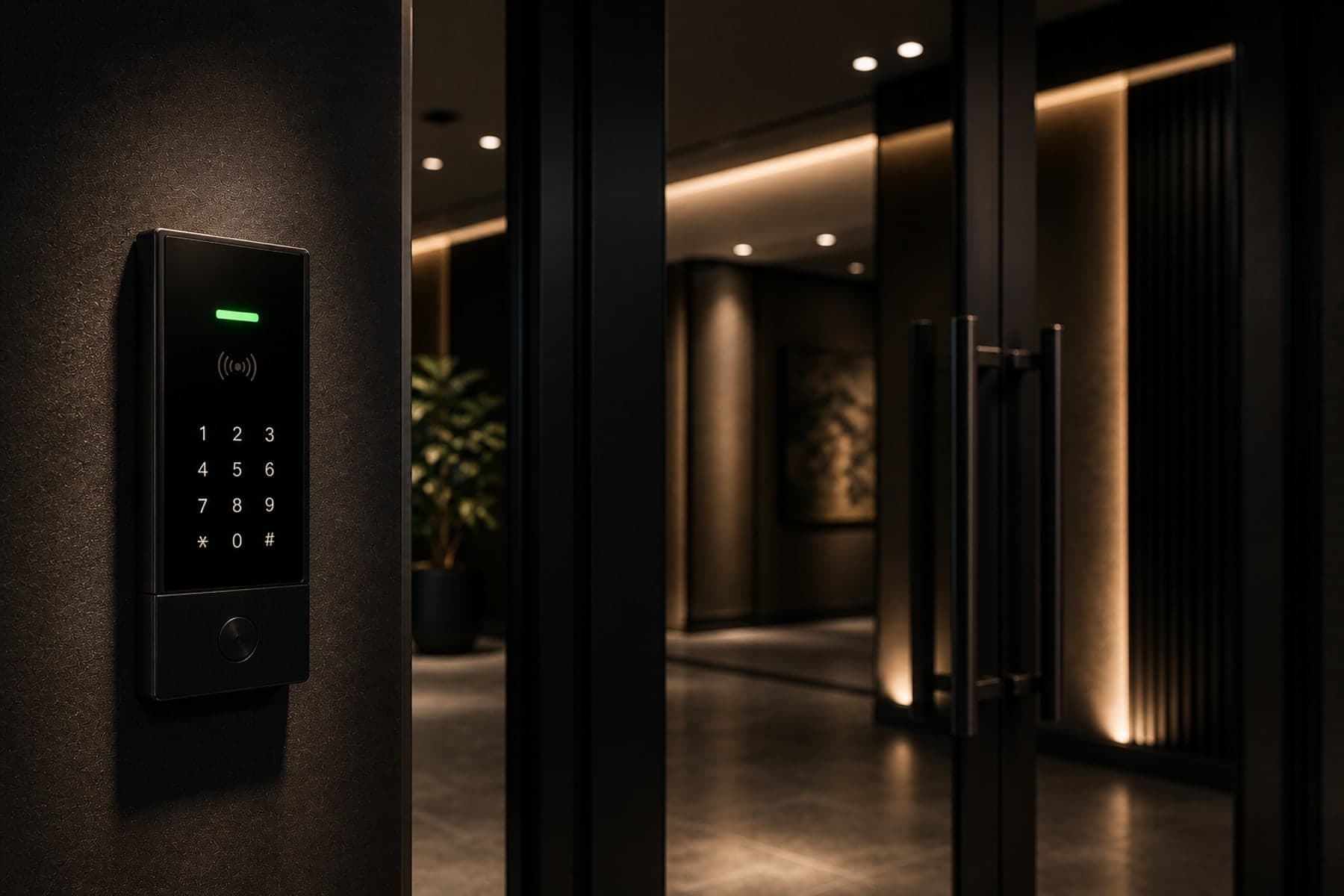
Access control hardware is one of the few systems in a building where the engineering decision sits squarely between two non-negotiables. Fail-safe means the door unlocks when power is removed. Fail-secure means it stays locked. Both are correct for some doors and dangerous for others, and the choice is per-door, not per-building.
The decision is driven by two questions. First: is this door on an egress path? If yes, it must be fail-safe — occupants must be able to exit when power fails or when the fire-alarm fires, regardless of the access-control system's state. Second: is this door on a perimeter or guarding a high-security asset? If yes, fail-secure is usually right — an attacker who pulls the building's main breaker should not have the perimeter handed to them.
Access architecture
Credential to door — and who decides
The hardware is the easy half. The half that causes handover disputes is the policy layer: who is allowed where, who administers it, and what the door does when power fails.
01
Credential
How a person presents identity at the door.
- Card and fob credentials
- Biometric or mobile credentials
02
Reader & controller
Reads the credential and makes the local allow / deny decision.
- Door reader
- Door controller with local decision cache
03
Door hardware
The physical lock and its fail-safe or fail-secure behaviour.
- Electric lock or magnetic lock
- Door position and request-to-exit devices
Fire-alarm release
Doors on escape routes release on fire alarm. Whether a door is fail-safe or fail-secure is a life-safety and security decision taken jointly — never a default left to the installer.
04
Management software
Holds the access policy, the audit trail and the joiner-mover-leaver process.
- Access-management server
- Audit and reporting
Illustrative discipline-level chain. Door schedules, credential policy and site layouts are project-confidential and never published.
The fire-alarm cause-and-effect resolves most of the doubt
On any door where there is genuine doubt about which choice applies, the fire-alarm cause-and-effect resolves it. The matrix specifies which doors release on a fire-alarm trigger, and any door that releases on the matrix must be fail-safe in its hardware. The matrix is the contract; the hardware implements the contract. Where the matrix says 'release on Zone 3 alarm', the door's electromagnetic lock or strike has to be fail-safe, and the matrix's release relay has to interrupt the lock's power supply. Anything else risks a door that the matrix says is unlocked but the hardware says is still locked, and that gap is what kills people.
The egress-path test is the simple form of the question
For most buildings, the per-door classification reduces to a simple test: is this door part of the route an occupant would take to exit the building? If yes, fail-safe. The route includes the corridor doors, the stairwell doors, the lobby doors, and the final external door. All of these must release on the fire-alarm matrix; all of these must be fail-safe in hardware.
The exceptions are doors that are not on the egress path: server rooms, drug stores, plant rooms, perimeter gates, secure stores. These doors are typically fail-secure in hardware — they stay locked on power failure, and they have a separate egress path (a secondary door, an emergency override) for any occupant who happens to be inside when power fails. The fire-alarm matrix can still trigger them to unlock if the brief requires (e.g. a server room with a fire-suppression system that needs the door open for ventilation), but the default is locked.
Magnetic locks vs electric strikes — the hardware translation of the choice
Magnetic locks (maglocks) are inherently fail-safe: they hold the door closed by magnetism, and removing power releases them. Electric strikes can be specified as either fail-safe (releases on power loss) or fail-secure (stays locked on power loss); the spec has to be explicit on the order. Mortise locksets with motorised retraction are usually fail-secure unless explicitly specified otherwise. We translate the per-door classification into a hardware schedule on every project, with the door's role, its fail-state, its release-source on the fire-alarm matrix, and its hardware part number recorded in writing.
Where the architect specifies a maglock on a high-security door, we flag the issue early — a maglock is fail-safe, and a fail-safe perimeter door fails the security brief. The conversation with the architect produces either a fail-secure electric strike, a maglock with secondary mechanical security (deadbolt that engages on power loss), or an explicit acceptance that the perimeter is fail-safe for fire-safety reasons.
Free-egress hardware is non-negotiable on every door
Regardless of fail-state, every access-controlled door must permit free egress from the inside. The reader is on the outside; the inside has a request-to-exit button (REX), a passive infrared sensor, or a mechanical handle that releases the lock without authentication. We check the free-egress hardware on every commissioning and we test it on every quarterly AMC visit. A door that fails the free-egress test is taken out of service the same day; the alternative is a building that can lock its occupants in.
Callout — what buyers most miss
The classification is per-door, signed by the fire-safety officer, and recorded in the as-built drawings. Most access-control deployments record the door schedule in the access-control system's configuration but not in the fire-safety as-built. That gap means a future contractor can swap a door's fail-state without anyone noticing the change. We record the per-door fail-state classification in both the access-control configuration and the fire-safety as-built, signed by the fire-safety officer, so any future change is visible to both systems.
Reference deployment context
On the Tinsukia Medical College & Hospital deployment, access control runs across clinical, administrative and plant zones, and every access-controlled door carries a fail-state classified against its egress role. Theatre doors were specified as fail-safe with manual override (the OT team can override on emergency); drug stores and pharmacy doors were fail-secure with REX; corridor doors on egress paths were fail-safe and released on the fire-alarm matrix; the records-room and the medical-records archive were fail-secure with separate egress on a secondary door. The classification is in the as-built and the AMC log; door counts and the door schedule stay in the project record.
References
1. NBC 2016, Volume 2 — fire and life-safety provisions for egress.
2. NBC 2016 Part 4 — means-of-escape provisions.
3. NFPA 101 (Life Safety Code, 2024 edition) — egress and door-hardware provisions.
4. UL 294 — Standard for Access Control System Units (door-strike fail-state designations).
/ Frequently asked
Quick answers from the practice.
- Can a door be both fail-safe and fail-secure?
- Conceptually no, but in practice you can pair a fail-secure strike with a fire-alarm-triggered release relay so the door behaves as fail-secure under normal operation and fail-safe on a fire-alarm event. This is the design for many high-security egress doors — IT server rooms with emergency egress through them, surgical suites with egress to a hot zone. The relay is the engineering work; the door hardware is identical.
- What does NBC say about egress doors?
- NBC 2016 Part 4 (Fire & Life Safety) is the governing reference for egress: a door on an egress path is expected to release on a fire-alarm trigger and to let occupants out without a key, fob or card. Fail-safe with fire-alarm cause-and-effect release is the specification we design to. Fail-secure on an egress path is the kind of detail the AHJ will raise at occupancy inspection — confirm the requirement for your building with the licensed fire consultant on record.
- Are magnetic locks (maglocks) acceptable on egress?
- Only when paired with a request-to-exit sensor, an emergency push-bar override, and a fire-alarm cause-and-effect release. Maglocks alone on egress are not code-compliant — the failure modes (loss of power without proper release wiring) trap occupants. We typically prefer electric strikes over maglocks on egress paths for this reason.
- What about computer-room doors with biometric access?
- Fail-secure under normal operation (protect the asset on power cut), fail-safe on fire-alarm trigger (allow egress under fire conditions). The biometric reader stays on independent UPS so card-only fallback works during a power blip without a fire event. This is the standard pattern for server rooms, drug stores, vaults and OT corridors.
- Will TechnoGuru document the fail-state per door at handover?
- Yes. The door-by-door fail-state register is a standard deliverable — fail-safe vs fail-secure, fire-alarm release relay, request-to-exit sensor, push-bar override, retention against any deviation. Signed off by clinical engineering or facilities, the AHJ, and the architect.
/ What to do next
Three next steps for access-control scope
- Read the access-control service page →Engineering scope, brand bands, fail-state discipline.
- Read the fire-alarm cause-and-effect insight →How access-control integrates with the matrix.
- Send the door schedule →We mark up the fail-state register against your architectural egress plan.
Engineering toolkit
Tools that go with this read
If this article gave you a question worth pricing, these calculators give a defensible first number.
- ELV · Surveillance
CCTV Coverage Calculator
Building dimensions and risk profile in, recommended camera count, retention storage and bandwidth out. Densities are planning conventions, not a code rule.
Cameras · TB · MbpsOpen - Site planning
Industrial & Tea-Estate Technology Planner
Site type, zones and what's ready in — which systems to coordinate (CCTV, PA, access, networking, UPS, fire/ELV), what to prepare and a readiness view out. Advisory; no counts, layouts or pricing.
Advisory · readiness · copyableOpen - Healthcare · Readiness
Healthcare ELV Readiness Checker
A readiness self-check for a hospital, diagnostic centre or clinic coordinating nurse call, CCTV, access, fire alarm + PA, network, patient TV and BMS for critical HVAC — with the gap list and who owes what. Statuses and bands only; no bed counts, layouts or camera specifics.
Advisory · readinessOpen
/ Services this article informs
Read the discipline pages.
/ Reference work
Projects where this engineering shows up.
Editorial — about this surface
TechnoGuru Fire & Life-Safety Practice
The fire and life-safety practice runs the discipline that the state fire service signs against. Addressable detection design, cause-and-effect logic, PAVE voice-evac and emergency lighting — engineered against the National Building Code, the relevant state amendments and the field realities of how a building actually evacuates.
Reviewed against NBC, IS 2189 and the relevant state fire-service requirements — every recommendation is held to what passes NOC and field cause-and-effect verification.
Last reviewed
12 May 2026
Engineering domains
Addressable fire detection · Cause-and-effect logic engineering · Public-address voice evacuation (PAVE) · Emergency lighting design
Operating environments
Mid-rise and high-rise commercial · Hospitality and healthcare buildings · Government and institutional facilities · Assembly and gathering venues
/ Discuss your project
If this article matches a brief you are working on, the next step is a short brief — a project lead replies to it directly.
We do not run sales pipelines. The first reply comes from a project lead, within two working days, and it goes straight to the engineering question rather than a brochure.